GuingesRock wrote:NASH wrote:Secondary dry-hopping will always be best for results and repeatable control

Greg, Do you have any comment on secondary dry hopping vs. dry hopping in the keg please?
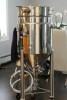
I've dry-hopped in kegs as a homebrewer and in serving tanks in breweries. For consistency you'll want to dry-hop for 3 days, or 6 days, or 9 days, whatever your preference for effect, 'your' recipe. It doesn't make sense to be depressurizing the vessel to remove hops from a tank of finished beer, it'll gas-out, you'll disturb sediment and or hop particulate etc. So how long is your beer on tap, 1 week, 2 weeks, 2 months? It will continuously change over time, after a point as unwanted matter leeches out it will not be for the better, chlorophyll and God knows what all comes into play. Some pro brewers won't dry-hop any longer than 3 days, and they do it multiple times, ejecting the spent hops from the conical bottom each time before hitting it with the next dose. Almost all big, delicious highly-rated hopped up beers from the famous brewers south of the border are dry-hopped multiple times. I wouldn't dry-hop anything longer than 10 days, tops. All I want from hops at this stage are precious essential oils, they only need enough time to melt into solution.
Don't get me wrong, back in the nineties I've had tanks of beer with kgs of bagged hop flowers in them for up to two months, possibly longer. The beer was still good, not great, nothing like it used to be and certainly not at all like the next batch coming in behind it.
I should note a few things: If I were going to pack hops inside of something, it'd be the teaball sort of device, that said you'll never get the sort of extraction potential by placing hops inside anything other than a tank full of beer. I do all dry-hopping after the primary ferment is complete and yeast has mostly dropped. Then I remove the yeast, I don't want hop pellets sinking into a yeast cake, that'd be somewhat inefficient. I don't want more yeast settling on top of the hops and I surely don't want autolysis occurring. I do all dry-hopping at 60 F or above and rouse the hops daily by briefly injecting CO2 into the bottom of the tank. This helps sink any floating hop matter as you're knocking out O2 and saturating them with sweet sweet beer. This also helps eliminate oxidation. Oxidation from the hops themselves, no matter the form pellets or cones, they're full of oxygen. There are many ways you can easily do this as a homebrewer if you think about it. It lends staying power to the finished brew and benefits oil extraction tremendously since you're physically 'stirring' the bed of hops. That bed is packed full of 'stuck' oils that would otherwise take much much longer to homogenize. Get 'em in, get that precious oil and get 'em out